

A 24% APR doesn’t look scary.
It’s just a number on your credit card statement.
But turn that percentage into dollars — and suddenly it feels very different.
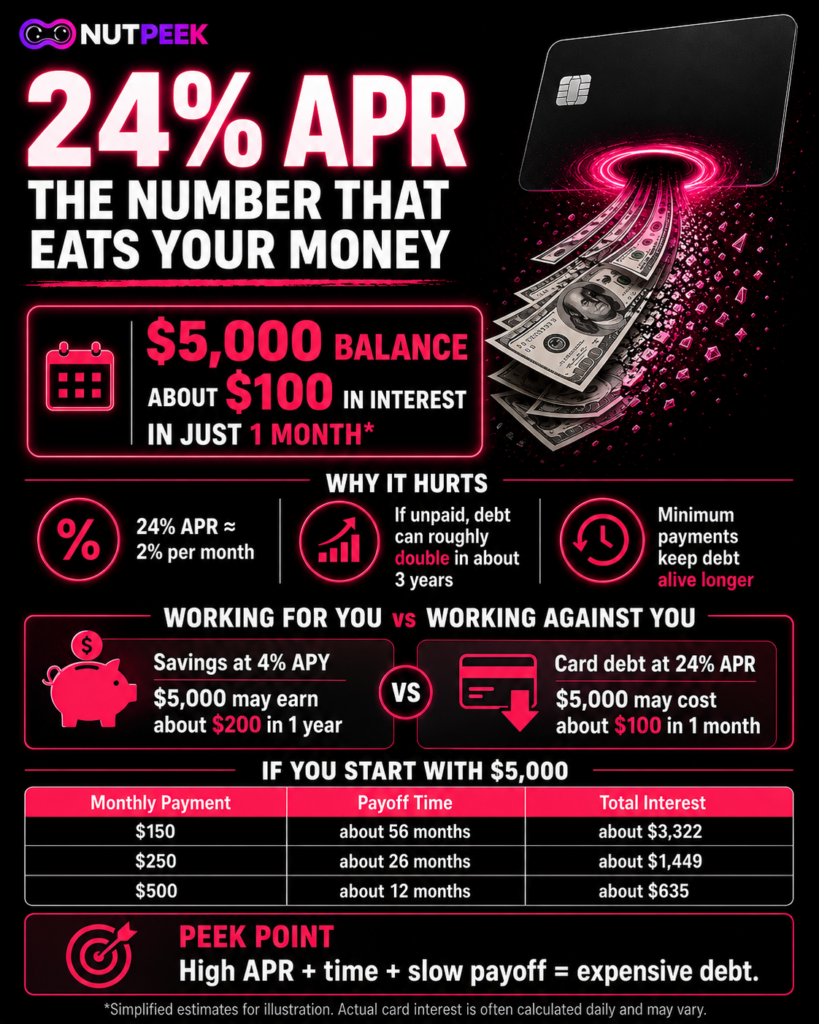
A $5,000 credit card balance at 24% APR can generate roughly $100 in interest in just the first month.
Here’s another way to feel how big that number is.
A hypothetical $5,000 savings balance earning 4% APY would earn about $200 over an entire year.
A $5,000 credit card balance at 24% APR can cost roughly $200 in about two months, using a simplified monthly estimate.
One year to earn about $200.
About two months to lose about $200 to interest.
That’s what 24% really looks like.
24% APR in Dollars
APR stands for annual percentage rate.
A simplified way to picture 24% APR is:
- 24% per year
- roughly 2% per month
- roughly 0.066% per day when divided by 365
Now forget the percentages for a second.
Look at the dollars.
| Credit Card Balance | Approx. First-Month Interest |
|---|---|
| $1,000 | about $20 |
| $2,500 | about $50 |
| $5,000 | about $100 |
| $10,000 | about $200 |
So if you’re carrying a $10,000 balance, a simplified estimate puts just one month of interest at around $200.
That’s $200 that does not make the original $10,000 disappear.
These figures use a simplified APR ÷ 12 estimate. Actual credit card interest charges can differ based on the issuer, daily balance, billing cycle, payments and other account terms.
24% Is Bigger Than It Looks
Percentages are difficult to feel.
Time makes them easier to understand.
Consider these two hypothetical examples:
| Scenario | Rate | What the Rate Means |
|---|---|---|
| $5,000 in savings | 4% APY | about $200 earned in 1 year |
| $5,000 credit card balance | 24% APR | about $100 interest in month one |
| $5,000 credit card balance | 24% APR | about $200 interest in roughly 2 months* |
Simplified comparison assuming the balance remains around $5,000.
The 24% rate is six times the 4% rate.
But there’s an even more important difference.
One is working for your money.
The other is working against it.
What Does 24% Look Like Over Time?
Here’s another way to understand how large a 24% annual rate is.
The Rule of 72 is a common mental shortcut for estimating how long an amount growing at a fixed rate could take to double.
72 ÷ 24 = 3
So purely as a mathematical rate comparison, 24% is roughly in the territory where an untouched amount could double in around three years.
That does not mean your real credit card balance will automatically double every three years.
Real credit cards involve payments, new purchases, daily-balance calculations, fees, grace periods and different account terms.
The point is simpler:
24% is a very fast rate when you give it time.
Compounding feels great when growth is working for you.
It feels very different when a high rate is working against money you owe.
What $5,000 at 24% Can Really Cost
Now let’s start with:
Balance: $5,000
APR: 24%
New purchases: $0
Using a simplified monthly interest rate of 2%:
| Monthly Payment | Approx. Payoff Time | Approx. Total Interest |
|---|---|---|
| $150 | about 56 months | about $3,322 |
| $250 | about 26 months | about $1,449 |
| $500 | about 12 months | about $635 |
Look at that first row again.
Original balance: $5,000
Approximate interest: $3,322
That means this simplified example can turn a $5,000 balance into more than $8,000 in total payments when repayment is slow.
Now compare that with paying $500 per month.
Same starting balance.
Same 24% APR.
But dramatically less time for interest to keep accumulating.
The rate didn’t change.
The time did.
You Pay $150. But the Debt Barely Moves.
This is where high-interest debt can become frustrating.
Imagine you owe $5,000 at 24% APR.
The simplified first-month interest is around $100.
You make a $150 payment.
A large portion of that payment is effectively offset by the cost of interest before the balance meaningfully falls.
You sent $150.
But your debt may have fallen by only a fraction of that amount.
Do that month after month and suddenly it becomes easier to understand why a relatively ordinary credit card balance can take years to eliminate.
Why Minimum Payments Can Keep You in Debt for Years
Minimum payments can help keep an account current.
But staying current and eliminating debt quickly are two very different things.
The smaller your payment:
- the longer the balance can remain
- the longer interest has to accumulate
- the more total interest you may ultimately pay
Federal credit-card disclosure rules specifically require issuers to calculate estimated repayment periods based on minimum-payment formulas and the APRs that apply to an account.
The lesson is simple:
Minimum payment does not mean optimal payment.
Paying more than the minimum, when possible, can dramatically change both the repayment time and the total interest cost.
But 24% APR Does Not Mean You Always Pay Interest
There is an important distinction.
Many credit cards provide a grace period for purchases.
If your card has a grace period and you pay the statement balance in full by the due date, you can generally avoid interest on qualifying purchases.
So these two situations can look completely different:
24% APR + statement paid in full → potentially $0 purchase interest
24% APR + balance carried forward → interest can become expensive quickly
Same card.
Same APR.
Very different outcome.
Not Every Transaction Uses the Same APR
A credit card may also have different rates for:
- Purchases
- Cash advances
- Balance transfers
- Promotional offers
- Penalty APRs
So a 24% purchase APR does not necessarily mean every transaction on the card is charged at exactly 24%.
Your card agreement and monthly statement show the rates that actually apply to your account.
The NUTPEEK Number
Forget everything else for a second.
If there’s only one number you remember from this page, make it this:
$5,000 × 24% APR ≈ $100 in interest in month one.
And one more comparison:
Hypothetical 4% savings:
about $200 earned in one year
24% credit-card balance:
about $200 of interest in roughly two months
That’s how big the gap can feel when a high rate starts working against you.
Bottom Line
24% APR is not just “a high percentage.”
Convert it into dollars and time.
$5,000 → about $100 in first-month interest
Pay slowly, and thousands of dollars in additional interest can accumulate.
Pay faster, and you dramatically reduce the amount of time the rate has to work against you.
The equation worth remembering is:
High APR + time + slow payments = expensive debt.
Suddenly, 24% doesn’t look like such a small number.
Keep Peeking
Want to see what time can do when growth works for you instead of against you?
See what happens when you invest $500 a month →
Examples are illustrative and use simplified monthly calculations for ease of comparison. Actual credit card interest charges may vary based on the issuer, average daily balance, billing cycle, fees, payments, purchases and applicable APRs.
This content is for informational and educational purposes only and is not financial, investment, tax, or legal advice. Consider your own circumstances and consult a qualified professional when appropriate.