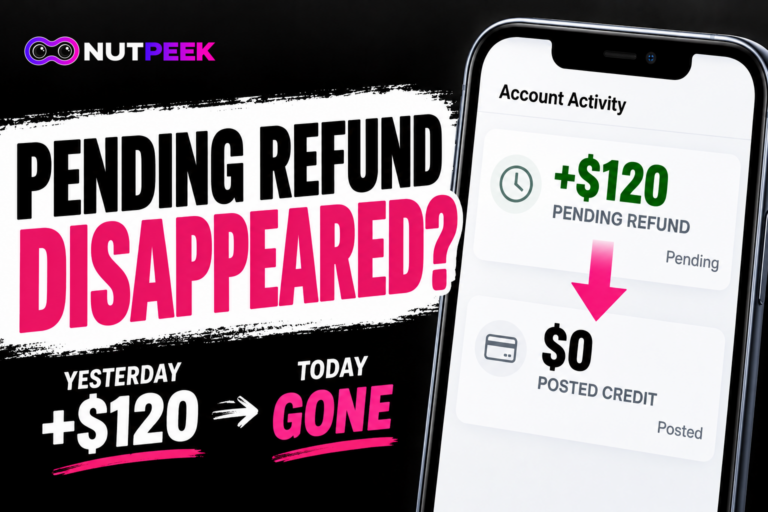

Pending transaction disappeared but no refund? First check whether the purchase moved to posted and whether your available credit or bank balance returned.
If it moved to posted, there was no refund — the purchase finished processing. If it did not post and the held amount became available again, the authorization may have been released before a final charge posted.
The missing pending line alone is not the answer. Use posted activity, available funds, and the merchant’s order status to decide what happened next.
Pending Transaction Disappeared but No Refund? Start Here
First, look for the purchase in your posted transactions.
A pending credit-card transaction is an authorization that has not yet been fully processed by the merchant. Once the merchant finalizes it, the transaction becomes part of your account balance.
The final amount can differ from the pending amount, so do not search only for the exact same number or merchant label.
| What you see next | What likely happened | Refund line? |
|---|---|---|
| $75 moved to posted | The purchase finished processing | No |
| No posted charge + credit returned | The authorization hold may have been released | Usually no |
| Order still active | The purchase may still be completed or reauthorized later | Not enough information yet |
If It Posted, Nothing Was Refunded
If you find the purchase under posted transactions, the pending line did not vanish into nowhere. It simply moved from pending to posted.
That is the most ordinary explanation, and it is why the first check should always be the posted-transaction list.
If It Did Not Post, Check Whether the Hold Was Released
Now suppose the charge is not posted and your available credit came back.
Example:
Yesterday: $75 purchase — PENDING · available credit $925
Today: pending line — GONE · posted charge — NONE · available credit $1,000
That pattern points toward the authorization hold being released rather than a refund being issued.
Visa’s merchant guidance says authorization reversals are used when an approved transaction will not be completed. The reversal tells the issuer that the authorization should be released rather than left holding the cardholder’s funds or available credit.
That is why a canceled or voided purchase can leave no separate refund line: there may have been no final posted charge to refund.
But Check the Order Before You Spend the Credit Again
A disappeared pending line does not prove that the merchant can never charge later.
Visa documentation allows reauthorization in certain delayed-processing situations. So the end of one authorization does not guarantee that a still-valid purchase will never appear later.
That does not mean the charge definitely will return. It means the pending line alone does not prove either outcome.
If this was an online order, reservation or delayed shipment, check whether the merchant still considers the order active before treating restored credit as permanently free.
Why There May Be No Refund
A refund and a released authorization are different money events.
| Path | What happened |
|---|---|
| POSTED $75 → REFUND / CREDIT | A completed charge was sent back |
| PENDING $75 → HOLD RELEASED | A temporary authorization ended before a final charge posted |
In the second path, your available credit can return without any separate refund transaction. That is the key distinction behind pending transaction disappeared but not refunded.
If You Used a Debit Card
The same basic symptom can show up in a checking account, but watch the available bank balance instead of available credit.
Capital One says a pending debit-card transaction can affect available balance and, in some cases, never post at all. It gives canceled or voided transactions as a common example. When that happens, the available balance is restored and that specific transaction may disappear from the transaction list.
So on debit, a pending purchase can disappear and your available bank balance can return without a separate refund line.
Three Things to Check Before You Call
1. Did the purchase move to posted?
Search your posted activity for the merchant and a similar amount. The final amount or merchant descriptor may differ from what was pending.
2. Did your available credit or bank balance recover?
If the pending line disappeared and the held amount became available again, the authorization may have been released.
3. Is the order still active?
Check the merchant’s order, reservation or cancellation status.
If the order is still active, keep enough credit or money available in case the merchant later completes or reauthorizes the transaction.
If the status is unclear, ask the merchant: “Was this purchase canceled, or is it still expected to be submitted for final payment?”
Declined but Still Pending? That Is a Different Problem
If the purchase was declined but an authorization is still reducing available credit, see Card Declined but Money Is Pending? An Authorization May Have Survived.
Here, the symptom is the reverse: the transaction was pending, and then the pending line disappeared.
Hotels, Rental Cars and Gas Stations
Hotels, rental cars and gas stations use authorization holds a bit differently because the initial authorized amount may not match the final charge.
For those cases, see Rental Car Credit Card Hold Still There After Return? and Gas Station Hold on Credit Card: $40 Can Show as $175.
The useful question is still the same: did the original authorization become a posted charge, get released, or get replaced by another authorization?
How Long Should You Wait?
There is no single timeline that applies to every merchant, issuer, network and transaction type.
Capital One says its credit-card transactions usually post within 72 hours and can sometimes take up to 5 days. Chase says everyday pending credit-card transactions will likely process within 3–5 business days.
Those are issuer-specific examples, not universal card-network deadlines.
If the order status and account activity still do not make sense after your issuer’s normal processing window, contact the merchant and then the issuer with the transaction date and amount.
If You Do Not Recognize the Transaction
Treat that differently from a normal purchase you recognize.
If you do not recognize the transaction, contact your issuer right away. Issuer procedures vary.
Capital One, for example, tells its credit-card customers to start the fraud process immediately for an unauthorized pending charge rather than waiting for it to post. For an authorized transaction problem, its normal dispute process can work differently.
Follow the instructions from the bank or card issuer that actually holds your account.
Fast Answers
My pending transaction disappeared. Did I get my money back?
Not necessarily in the form of a refund. First check whether the transaction moved to posted. If it did not post and the held amount became available again, the authorization may simply have been released.
Can a disappeared pending transaction show up later?
It can, depending on what happened to the underlying purchase and how the merchant processes it. A disappeared pending line does not guarantee that the purchase will later post, and it does not guarantee that it never will.
Why did my available credit come back without a refund?
Because a pending authorization can reduce available credit before a purchase becomes final. If that authorization is released, the held credit can become available again without a separate refund entry.
Should I dispute a transaction that disappeared?
If nothing is currently posted, there may be no posted charge to dispute. If a charge later posts incorrectly, follow your issuer’s dispute process. If you do not recognize the transaction, contact your issuer right away because fraud procedures can be different.
What Matters Most
A missing pending line does not tell you the whole story.
First check whether the purchase moved to posted. Then check whether the held credit or bank balance came back. Finally, check whether the merchant still considers the order active.
That will tell you much more than waiting for a refund line that may never exist.
ONE LAST PEEK: Before you look for a refund, check whether the charge ever posted.
Sources
Capital One — Understanding pending credit card transactions
Capital One — Pending debit card transactions for bank accounts
Chase — What are pending transactions and how long do they take?
Visa — Authorization and Reversal Processing Requirements for Merchants
Visa — Core Rules and Visa Product and Service Rules