
Store card charged interest even though only a small balance was left? The charge may not be based only on what you still owed.
In a deferred-interest promotion, interest can build quietly from the original purchase date. If the promotional balance is not paid in full by the deadline, that accumulated interest can appear all at once.
NUTPEEK · Deferred interest estimator
Leave even a small promo balance, and interest from the whole promo period can come back.
See how the same leftover promotional balance can lead to different simplified estimates depending on when you paid down the purchase.
Your scenario
What happened during the promo?
Enter the promotional purchase, not everything on your card.
Runs in your browser. No account or personal card details needed.
Estimated deferred interest
Evenly · illustrative range
If the promotional balance is not paid in full by the deadline and the promotion remains valid.
How payment timing changes this estimate
This is a simplified estimate, not your card issuer’s payoff calculation.
How this estimate works
The model uses purchase amount, months, APR and the promotional balance left at expiration. It converts APR from a percentage to a decimal, then divides by 12 for an illustrative monthly rate. It sums monthly balances and applies that rate. Each range compares the balance just after versus just before a modeled monthly payment.
- Mostly early: most principal is paid down in month one.
- Evenly: the same principal amount is paid down each month.
- Mostly late: most principal is paid down in the final month.
These scenarios describe simplified histories, not a legal or actual minimum and maximum.
CFPB examples, for context
The CFPB illustrates a $4,500 purchase over 24 months at 31.99% APR with $180 left and a $1,439.55 deferred-interest charge. Its separate $400 TV example over 12 months at 25% APR with $100 left describes about $65 in interest.
These are official illustrative references, not validation of this estimator. The examples reflect particular payment assumptions; matching or overlapping numbers do not show that this tool reproduces an issuer’s bill.
Deferred interest vs. a true 0% introductory APR
“No interest if paid in full” can mean interest is accruing during the promotion and may be charged back to the purchase date if any promotional balance remains at expiration. A true 0% introductory APR does not retroactively charge interest for its 0% period; interest may apply to a remaining balance after that period under its terms. Check the exact offer and payoff date.
What this estimate leaves out
Issuers may use daily balances, exact payment dates, payment allocation rules, compounding, fees and offer-specific terms. Payments on other card balances may not reduce the promotional purchase as expected. You must still make required payments; being more than 60 days late can cause the deferred-interest period to be lost. Even one late payment can have other consequences.
For the amount you actually owe, use your issuer’s promotion terms, statements and payoff information.
Key Takeaways
- “No interest if paid in full” is usually not the same as a true 0% APR offer.
- With deferred interest, interest can accrue from the purchase date in the background.
- If even part of the promotional balance remains after the deadline, accumulated interest may be imposed.
- In the CFPB example, $180 left at the end triggered $1,439.55 in deferred interest.
- Minimum payments may not be large enough to clear the promotional balance on time.
Store Card Charged Interest? Why $1,439 Appeared With Only $180 Left
Because the $180 was the trigger, not the amount on which all of the interest was calculated.
The Consumer Financial Protection Bureau describes a $4,500 furniture purchase made with a 24-month deferred-interest promotion. The consumer pays down $4,320 and reaches the end of the promotion with only $180 remaining.
At a 31.99% APR, the CFPB says the deferred-interest charge would be $1,439.55.
That means the next amount owed could jump from $180 to approximately $1,619.55 before considering any other transactions, fees, or later interest:
Deferred interest added: $1,439.55
Total: $1,619.55
The shopper did not suddenly pay a 799.75% interest rate on the final $180. Instead, the card released interest that had been accumulating while the original promotional balance declined.
How the $1,439.55 Calculation Works
One simplified way to illustrate the CFPB example is to model the promotional balance falling evenly across the 24 months. That can reproduce the CFPB example amount, but it does not reconstruct the cardholder’s actual payment dates or the issuer’s daily-balance calculation.
After the first $180 payment, the promotional balance is $4,320. It then falls by $180 each month until $180 remains after the twenty-fourth month.
| Point in the Promotion | Promotional Balance |
|---|---|
| Original purchase | $4,500 |
| After payment 1 | $4,320 |
| After payment 12 | $2,340 |
| After payment 23 | $360 |
| After payment 24 | $180 |
Add the 24 month-end balances—$4,320, $4,140, and so on down to $180—and the balance-month total is $54,000.
Balance-month total: $54,000
$54,000 × 31.99% ÷ 12 = $1,439.55
This reconstruction matches the CFPB’s published figure exactly. It is an explanatory monthly illustration, not a claim that every issuer uses this precise method. Actual card agreements may calculate interest using daily balances, daily periodic rates, compounding, payment-posting dates, and other account-specific rules.
Deferred Interest vs. True 0% APR
These offers can sound almost identical at checkout, but the ending can be very different.
| If $180 Remains After the Promotion | Deferred Interest | True 0% Intro APR |
|---|---|---|
| Interest during promotional period | Accrues in the background | $0 during the 0% period |
| What happens at expiration | Accumulated interest may be imposed | Regular APR generally starts on the remaining balance going forward |
| Interest goes back to purchase date? | Potentially yes | Generally no |
| Need full payoff by deadline? | Yes, to avoid deferred interest | No retroactive interest, though the remaining balance can become expensive afterward |
The phrase to watch is often:
“No interest if paid in full within 24 months.”
The words “if paid in full” are doing most of the work. A true 0% APR promotion generally states that the promotional APR itself is 0% for a defined period.
Why Minimum Payments Can Leave You Short
A required minimum payment is designed to keep the account current. It is not necessarily designed to pay off a promotional purchase before its special deadline.
The CFPB specifically warns that minimum payments probably will not be enough to clear the full deferred-interest balance by the end of the period.
For a $4,500 purchase over 24 months, the simple principal target is:
$4,500 ÷ 24 = $187.50 per month
Paying $180 per month feels close. But after 24 payments, it leaves exactly $180 unpaid—and in this example, that small shortfall is enough to trigger the deferred interest.
High APR can make a small remaining balance expensive. See what 24% APR really costs.
Five Things to Check in the Card Terms
- The exact promotional wording. Look for “no interest if paid in full,” “deferred interest,” or “same as cash.”
- The promotion expiration date. It may not be the same as your regular payment due date.
- The promotional balance. Check the balance tied specifically to the offer, not only the card’s total balance.
- The accrued or deferred interest amount. Some statements disclose the amount that may be imposed if the balance is not paid in full.
- How payments are allocated. Other purchases or balances on the same card can affect where payments go.
How to Reduce the Risk of a Surprise Charge
- Divide the purchase by the number of promotional months before agreeing to the offer.
- Pay more than that simple monthly target when possible so rounding, timing, or a missed payment does not leave a small balance.
- Aim to finish one or two billing cycles early rather than on the final day.
- Avoid adding unrelated purchases to the same store card while paying down the promotion.
- Confirm that the promotional balance—not merely the statement balance—has reached $0.
- Contact the issuer before the deadline if the payment allocation or payoff amount is unclear.
This Is Not Residual Interest
Deferred interest can look similar to the small interest charge that appears after a credit card payoff, but the mechanics are different.
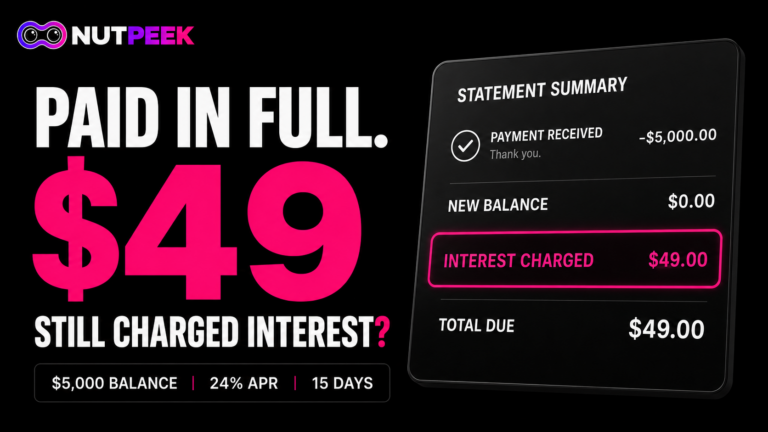
Residual interest can accrue for the days between a statement closing and the payoff posting when a balance is already subject to interest. In our separate example, 15 days on $5,000 at 24% APR was about $49.
Deferred interest can accumulate across an entire promotional period and become payable when the promotional balance is not fully cleared.
Read the difference in context: Still Charged Interest After Paying Off a Credit Card? Why $49 Can Show Up.
How Much Does 31.99% APR Normally Cost?
A 31.99% APR is expensive even without deferred interest.
But the surprise in this example comes from timing: almost two years of accumulated interest can land on one statement instead of appearing month by month.
For a simpler explanation of how a high annual rate turns into monthly dollars, see What 24% APR Really Costs You.
FAQ
Why did my store card charge interest after the promotional period?
If the offer was a deferred-interest plan and the promotional balance was not paid in full by the deadline, the issuer may impose interest that accumulated from the original purchase date. Check the exact offer and cardholder agreement.
What does “no interest if paid in full” mean?
It generally means you can avoid the accumulated interest only by paying the entire promotional balance within the stated period. It is different from a true 0% APR period in which the promotional interest rate is actually zero.
Can $1 left trigger deferred interest?
Potentially, yes. The controlling issue is whether the promotional balance was paid in full under the card’s terms. The amount of deferred interest depends on the purchase balance, APR, payment timing, promotion length, and issuer calculation method.
Can a late payment end a deferred-interest promotion?
The CFPB says a consumer may lose the deferred-interest benefit if they are more than 60 days late making a minimum payment. A single late payment may still cause late fees or other consequences, so review the agreement and pay on time.
Is the $1,439.55 figure a typical charge?
No. It is the CFPB’s specific illustration using a $4,500 purchase, a 24-month promotion, a 31.99% APR, and $180 remaining. Your result may be much lower or higher.
Sources
Consumer Financial Protection Bureau — The High Cost of Retail Credit Cards
Consumer Financial Protection Bureau — How deferred-interest promotions work
The $1,439.55 figure is a CFPB illustration. NUTPEEK’s reconstruction uses 24 equal $180 principal payments and a simplified monthly APR calculation to show how that published figure can be reached. Actual issuer calculations and contract terms may differ.
This content is for informational and educational purposes only and is not financial, legal, or tax advice.